Trump Orders US Navy To ‘Shoot And Kill’ Iranian Boats Laying Mines In Strait Of Hormuz
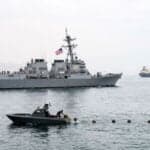


US President Donald Trump has ordered the US Navy to “shoot and kill” any small Iranian boats that are laying mines in the Strait of Hormuz.
In a social media post on Thursday, Trump said there should be “no hesitation” in targeting any vessels deploying mines in the strait. He also said US minesweeping operations in the waterway were continuing at “a tripled-up level”.
The order came as the US said it had intercepted another tanker carrying Iranian oil in the Indian Ocean.
The Pentagon said American forces conducted a maritime interdiction involving the tanker Majestic X, releasing video footage showing US personnel boarding the vessel.
The ship was intercepted between Sri Lanka and Indonesia and was reportedly heading toward China.
According to US officials, the tanker had earlier been sanctioned for carrying Iranian oil in violation of restrictions.
The vessel had also changed names and was previously linked to smuggling allegations. Authorities in Guyana said the ship was not registered there and was wrongly using its flag.
The Strait of Hormuz, one of the most important oil routes in the world, has become a major point of tension.
Around 20 percent of global oil and gas used to pass through it before the conflict. But shipping through the area has dropped sharply since the war began in late February.
Iran has restricted traffic in the strait in response to the conflict and has said it has rights over the passage, which connects the Gulf to the Indian Ocean. Some parts of the waterway pass through Iranian territorial waters.
The disruption has pushed oil prices higher, adding pressure in the United States, where fuel prices have risen above $4 per gallon from around $3 before the conflict.
US officials said more than 100 ships used to pass through the strait daily in normal conditions, but now only a few vessels are crossing. On Wednesday, at least eight ships passed through, including three oil tankers.
The US has also kept a naval blockade on Iranian ports in place. Officials said dozens of vessels have been ordered to turn back as part of the operation. US Central Command said 33 ships have so far been directed away.
Trump said the US has “total control” over the Strait of Hormuz and claimed no ship can pass without approval from the US Navy. He also said the area is “sealed up tight” until Iran agrees to a deal.
Earlier this week, US forces also seized another vessel linked to Iranian oil shipments and ordered several ships in the region to change course.
Iran has responded by saying it will defend itself and will not accept US pressure. Iranian officials have also carried out seizures of foreign commercial vessels in the strait, saying they violated maritime rules.
Iran’s parliament speaker Mohammad Bagher Ghalibaf said reopening the strait is not possible while the US blockade continues. Iran has made lifting the blockade a condition for resuming talks with Washington.
The US has extended a ceasefire that was due to end this week, but has kept its restrictions on Iranian shipping in place.
Negotiations between the two sides have not taken place recently, with both sides blaming each other over conditions for talks.
Trump also said there is confusion within Iran’s leadership and claimed there is infighting between different groups.
Iranian President Masoud Pezeshkian rejected this, saying there are no divisions in the country and that Iran remains united.
Iranian Foreign Minister Abbas Araghchi and Parliament Speaker Mohammad Bagher Ghalibaf have also publicly supported the same position against the US blockade.
The Islamic Revolutionary Guard Corps (IRGC) has also issued statements backing Iran’s position, while praising those involved in the conflict.
The US has also increased its military presence in the region, with multiple aircraft carriers now deployed in surrounding waters, including the Arabian Sea and Red Sea.
Shipping experts say the risk of mines in the Strait of Hormuz remains a serious concern for commercial traffic, especially if ships return to normal routes in the future.
Insurance costs and security risks have already made shipping through the region difficult, and most companies are waiting for a stable ceasefire and clearer safety guarantees before resuming regular operations.
References: Al Jazeera, CNBC
Want to read more?
Check out the full article on the original site