USS Tripoli Enters Active Combat Zone With 3,500 Personnel As US Expands Military Build-Up In West Asia
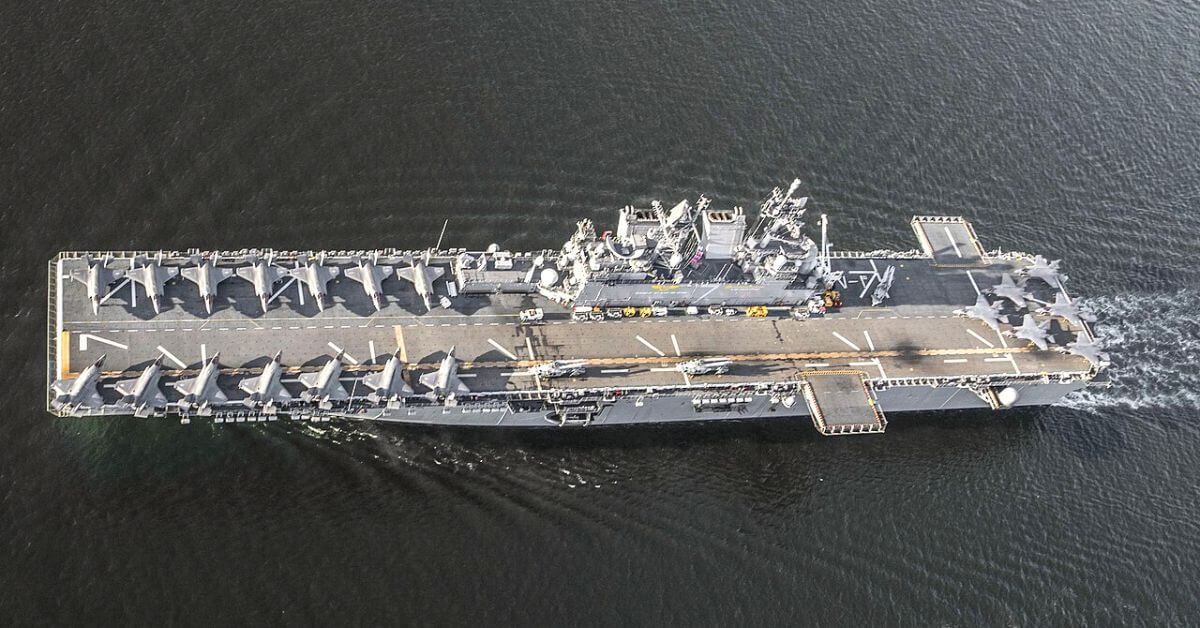
The United States has deployed the amphibious assault ship USS Tripoli to West Asia with around 3,500 Marines and sailors on board, as tensions with Iran continue.
The ship entered the US Central Command (CENTCOM) area of responsibility on March 27 after moving from its base in Sasebo, Japan.
According to CENTCOM, USS Tripoli is operating as part of the Tripoli Amphibious Ready Group and the 31st Marine Expeditionary Unit.
The vessel carries about 3,500 personnel along with transport aircraft, strike fighter jets, amphibious assault systems and other tactical assets.
It is an America-class amphibious assault ship, about 844 feet long, with a displacement of around 44,000 tons and a speed of over 20 knots.
The ship can operate F-35B fighter jets, MV-22 Osprey aircraft and multiple helicopters, giving it both air and ground combat capability.
The ship made a brief stop at Diego Garcia before entering the region. Its arrival means a full amphibious force with Marines is now positioned inside an active operational area in West Asia.
The US has also been increasing its overall naval presence in the region. Aircraft carriers from the Nimitz and Ford classes have already been deployed.
The USS George H.W. Bush carrier strike group has left Norfolk and is heading towards West Asia, which could bring the number of US aircraft carriers in the region to three.
At the same time, the USS Boxer, carrying at least 2,200 Marines from the 11th Marine Expeditionary Unit, has departed from San Diego and is expected to reach the region in less than a month. The USS New Orleans is also scheduled to join operations.
Meanwhile, the USS Gerald R. Ford, which had been deployed earlier in the region, is now at the Port of Split in Croatia after transiting from Souda Bay, where it carried out resupply, refuelling and repair work between March 23 and 26.
There were reports of a fire in one of its laundry areas and ongoing plumbing issues, which may keep the carrier out of service for some time.
US officials had earlier denied claims from Iranian-linked sources that the ship had been hit in an attack, stating that the issue was non-combat related.
U.S. Sailors and Marines aboard USS Tripoli (LHA 7) arrived in the U.S. Central Command area of responsibility, March 27. The America-class amphibious assault ship serves as the flagship for the Tripoli Amphibious Ready Group / 31st Marine Expeditionary Unit composed of about… pic.twitter.com/JFWiPBbkd2
— U.S. Central Command (@CENTCOM) March 28, 2026
The deployment is taking place during the ongoing US military campaign known as Operation Epic Fury. CENTCOM said that since February 28, US forces have carried out more than 11,000 combat flights and targeted Iranian-linked military infrastructure.
These operations have focused on missile sites, air defence systems, naval assets and facilities linked to the Islamic Revolutionary Guard Corps. According to the US, more than 150 vessels have been damaged or destroyed during these operations.
The US has also moved additional forces, including elements of the 82nd Airborne Division, with reports suggesting between 1,000 and 3,000 paratroopers could be deployed.
The situation remains tense around the Strait of Hormuz, one of the world’s busiest oil shipping routes.
Iran has rejected a US peace proposal and has asked for sovereignty over the strait as part of its conditions. The US has been pushing for the route to reopen and has extended its deadline for Iran to do so until April 6.
Houthi forces in Yemen, which are aligned with Iran, recently fired ballistic missiles towards Israel, though Israeli forces said the missile was intercepted and no damage or injuries were reported. The group has warned the US and its allies against further escalation.
Despite the military build-up, diplomatic talks are continuing. US Secretary of State Marco Rubio said negotiations with Iran are ongoing through intermediaries, including Pakistan, and that a resolution could be reached within weeks.
US President Donald Trump has said he does not intend to send ground troops, although some options under discussion could require forces on the ground.
References: ANI News, WION
Want to read more?
Check out the full article on the original site