New faculty books: Ordinary people and the global legal order, imperial policing, making of modern Taiwan, and poetry
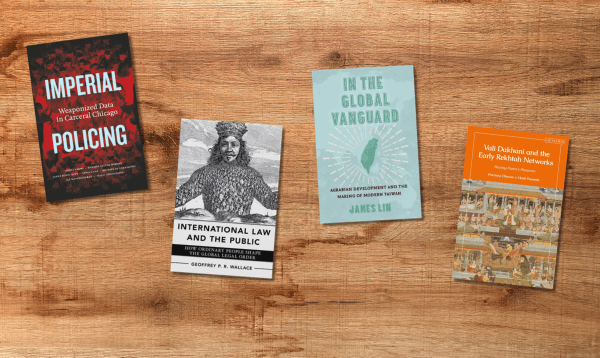

Recent books from University of Washington faculty and staff include those from legal studies at UW Tacoma, international studies, political science, history, and Asian languages and literature.
UW Tacoma assistant professor collaboration with Policing in Chicago Research Group
“Imperial Policing: Weaponized Data in Carceral Chicago” was collaboratively authored by Ilā Ravichandran, assistant professor of legal studies at UW Tacoma, and the Policing in Chicago Research Group. They developed the book in dialogue with those on the front lines of struggles against racist policing in Black, Latinx and Arab/Muslim communities.
“Imperial Policing” analyzes the connections between three police “wars” — on crime, terror and immigrants — with a focus on the weaponization of data and the coordination between local and national agencies to suppress communities of color and undermine social movements. Topics include: high-tech, data-based tools of policing; racialized archetypes; the manufacturing of criminals and terrorists; the subversion of sanctuary city protections; and abolitionist responses to policing, such as the Erase the Database campaign.
The book contains analysis and ideas for solutions at a critical political moment, and serves as a rare, vital example of scholars working directly with community organizations to map police networks and intervene in policing practices.
“‘Imperial Policing’ is an important offering that decenters normative modes of knowledge production and the academy itself and instead provides a model for collaborative knowledge production and change work that academics ought to take up and consider,” Ravichandran said. “This book deepens abolitionist analyses of U.S. Empire and broadens abolition as a necessary global coalitional framework.”
Modern Taiwan through an agrarian lens
“In the Global Vanguard: Agrarian Development and the Making of Modern Taiwan” is a recent book by James Lin, associate professor of international studies at the UW.
The book recounts the history of modern Taiwan through the lens of agrarian development. Starting in the 1950s, Taiwan sent international development missions to over two dozen nations across the Global South. From the 1950s to 1990s, Taiwan’s GDP per capita grew by 800%. While researching this growth, an article caught Lin’s attention: a report of how Taiwan’s efforts surrounding improved varieties of broccoli rabe would solve hunger, famine and malnutrition.
“How could broccoli rabe make the world a better place?” Lin wrote in a blog post about his book. “Over the next decade, I traced the arc of agricultural development in libraries and archives across the world, from Ithaca, New York to Shanhua, Taiwan. The more I delved into this question, the more I unearthed a time when Taiwan’s contributions to the world weren’t in advanced semiconductors, but rather rice and vegetables.”
In “In the Global Vanguard,” Lin examines how Taiwanese technicians and agricultural scientists introduced new crop varieties, extended new agricultural technologies and extolled the virtues of a Taiwanese approach to development across the Global South.
Lin argues the missions eventually shaped how the Taiwanese conceived their place in the world. At the same time, the Nationalist party-state of Taiwan co-opted agrarian science to position Taiwan as a modern nation, legitimizing the government’s authoritarian rule by martial law.
Ordinary people and the global legal order
“International Law and the Public: How Ordinary People Shape the Global Legal Order” examines an important, and often underappreciated, actor in international law.
Written by Geoffrey Wallace, professor of political science at the UW, the book is of interdisciplinary interest due to its combination of constitutional and international law theories and a wide range of quantitative and qualitative data.
When considering who counts in the international legal order, most answers focus on governments, leaders, generals, lawyers or other elites. Wallace integrates insights from law and political behavior to advance the idea of “popular international law,” where ordinary people are considered important legal actors.
“Drawing on a blend of experiments, conventional polling, media coverage and historical cases, this book shows the ways in which national publics can have an impact on core functions of international law,” Wallace said. “Insights from the book offer an account of international legal politics from below — taking seriously the place of ordinary people in international affairs.
Co-authored book began with love of 18th century poetry
“Vali Dakhani and the Early Rekhtah Networks: Sharing Poetry’s Pleasures” is a new book co-authored by the UW’s Purnima Dhavan, associate professor of history, and Heidi Pauwels, professor of Asian languages and literature. True to its subtitle, the book emerged from friendly conversations they had about early 18th century poetry in Urdu — a language that was called Rekhtah at the time.
Their interdisciplinary conversations led to the growing conviction that the diverse roots of this important vernacular tradition had become obscured through selective attention to a handful of poets associated with rarified imperial courtly environments. Poetic networks had become erased as poems were taken out of their social contexts and isolated in separate tomes by author.
“Vali Dakhani and the Early Rekhtah Networks” presents the evidence to reconstruct these lost literary networks of Urdu’s formative past. The book reframes the history of Urdu within the diverse context from which it emerged: lively social gatherings, bazaars, shrines and multiple courts of 18th-century South Asia, highlighting its engagement with diverse regional cultures and communities in South Asia.
The cover illustration, an 18th-century canvas by Mughal painter Chitarman II, vividly depicts the many literary references to “Lovers and Beloveds” featured in the poetry of this period, inviting the reader to join the authors in sharing its pleasures.
For more information, contact Lauren Kirschman at lkirsc@uw.edu
Want to read more?
Check out the full article on the original site