What to Eat, Shop and See on Maunakea Street in Chinatown
Our take
The enduring appeal of Hawai'i lies not just in its iconic beaches and luxurious resorts, but in the preservation of its authentic cultural heartbeats. The recent piece highlighting Maunakea Street in Chinatown perfectly encapsulates this sentiment, reminding us that amidst the rapid development reshaping O‘ahu, pockets of genuine local experience remain. It’s a welcome counterpoint to the increasingly polished and often homogenized offerings elsewhere, a testament to the enduring spirit of community and tradition. This resonates deeply with our audience who seek those unique, unfiltered moments that truly define the Hawaiian experience, something we’ve explored previously in our feature 17 Hawaii Experiences That Feel Unreal | Best of Hawaii: Maui, Kauai, Oahu & Big Island which celebrates the magic found in unexpected places. The author’s observation that Chinatown remains a place where one can still “afford to eat out” speaks volumes about its resilience and its role as a vital cultural and economic hub for many.
What's particularly compelling about the article is its deliberate rejection of trends and Instagrammability. Chinatown isn’t striving to be the next hot spot; it simply *is*, a living, breathing neighborhood that prioritizes functionality and community over fleeting popularity. This is a refreshing perspective in a world saturated with curated experiences. The piece also subtly underscores the importance of supporting local businesses and the preservation of historic neighborhoods, a theme we’ve touched upon in our look at the enduring legacy of The Local Scoop at Asato’s, demonstrating how traditional establishments contribute to the cultural fabric of Hawai’i. The lack of concern for external validation is a powerful statement, suggesting a quiet confidence and a deep connection to its roots. It's a space where generations have gathered, where traditions are passed down, and where the true essence of O‘ahu’s diverse heritage can be found.
The significance of this development—or rather, the lack of dramatic development—lies in its quiet defiance of the prevailing forces of gentrification. While Kaka‘ako and Waikīkī are transforming into gleaming showcases of modern luxury, Chinatown remains a haven for affordability and authenticity. This preservation isn’t merely about nostalgia; it’s about ensuring that a vital part of O‘ahu’s identity isn’t lost in the pursuit of progress. The article implicitly acknowledges the fragility of these spaces and the ongoing need to protect them from forces that threaten to erase their unique character. It’s a reminder that true luxury isn’t always about opulence; sometimes, it’s about experiencing the genuine heart and soul of a place, connecting with its history, and supporting the people who call it home. And while the area might not be vying for photo contest recognition – as showcased by The Winners of HAWAIʻI Magazine’s 2026 Photo Contest – its intrinsic beauty and cultural richness are undeniable.
Looking ahead, the question becomes: how can we, as a community and as travelers, actively support the preservation of spaces like Maunakea Street? Can we balance economic development with the need to protect cultural heritage? The ongoing success of Chinatown, and similar neighborhoods across Hawai’i, hinges on our collective commitment to valuing authenticity over fleeting trends, and to prioritizing the well-being of local communities over the pursuit of superficial luxury. It’s a challenge, but one that is essential to ensuring that the true spirit of Hawai’i endures for generations to come.
This story was originally published in our SUMMER Digital issue, which you can view here.
Chinatown is one of the last neighborhoods on O‘ahu where I can still afford to eat out.
Far from the glitz of Kaka‘ako and Waikīkī, the historic district doesn’t care about being Instagrammable or cutting-edge. Everyone is busy moving pallets of fish, fruit and meat carcasses. And chopping roast pork and hand-pleating hundreds of dumplings. And feeding people.
Photo: Aaron K. Yoshino
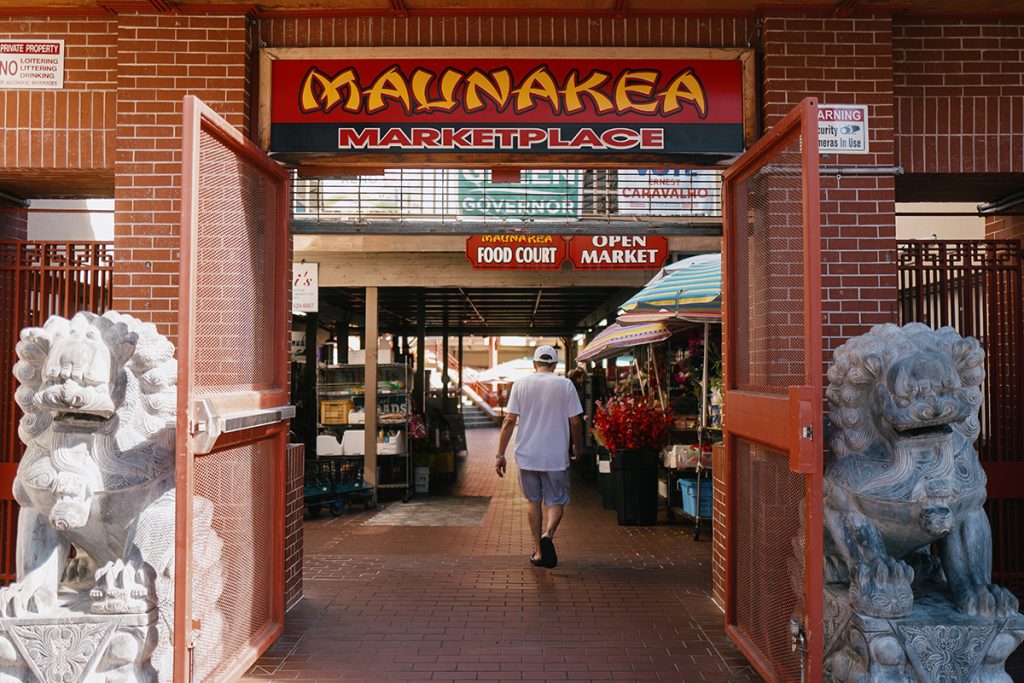
Maunakea Street is at the center of all the action, a microcosm of Chinatown’s bustling rhythm, packed into two blocks between North King and North Pauahi streets.
On this Sunday morning, I duck into HK Café to escape a steady June downpour. At 10:30 a.m. a few customers sip coffee while a soap opera blares from the big screen overhead. I order a hot Hong Kong-style milk tea with no sugar and the café’s signature French toast—two thick slabs of white bread, battered in egg, seared crisp and dusted in Ovaltine. When I drag a butter knife through the middle, condensed milk rushes out, flooding the plate. The woman from Hong Kong sitting next to me confirms Ovaltine’s popularity as a beverage and flavoring for desserts and candies in her native home. “This place does Hong Kong cuisine right,” she says. By 11:15 a.m. every table is full.
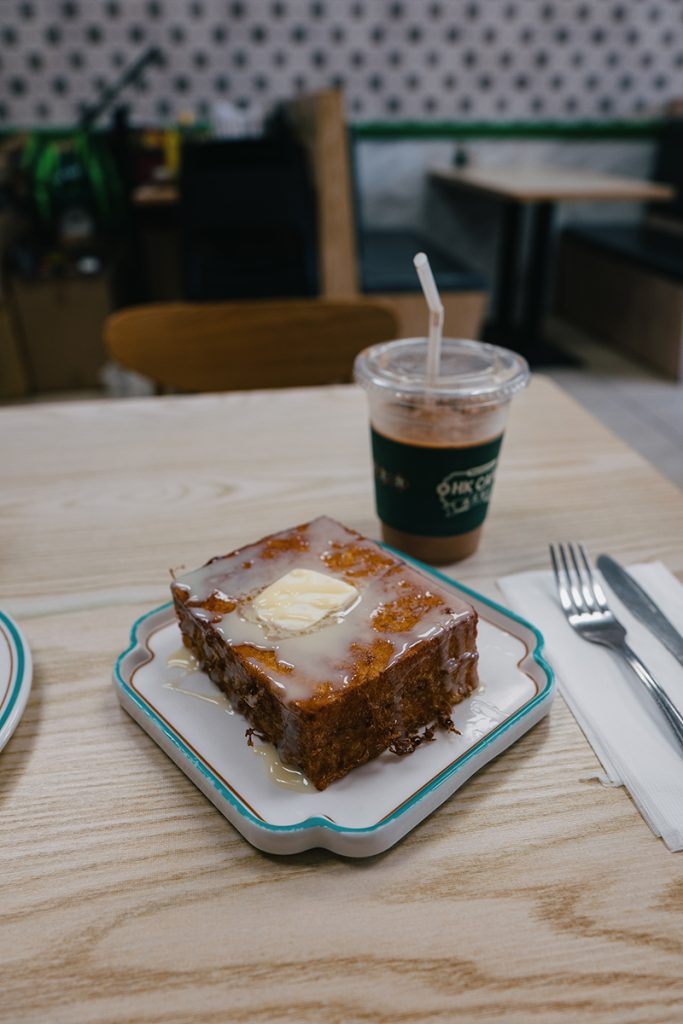
Photo: Aaron K. Yoshino
Afterward, I dip into DDJ Hawai‘i and get lost among heaps of jewelry, porcelain tea sets, gold Buddha statues and plush lion dance toys. The front door lures you in with its archway of red money envelopes and knot tassels. This is where you come for green or white jade at every price point. There are bangles, pendants and rings, with a dazzling two-room display that features not only jade, but also amber, coral and gold.

Photo: Aaron K. Yoshino
The Joseph P. Mendonca Building, home to HK Café and DDJ Hawai‘i, was built in 1901 after a series of devastating fires reshaped Chinatown. One blaze destroyed much of the neighborhood in 1886, and another followed after the discovery of Honolulu’s first case of bubonic plague in 1899. To contain the outbreak, officials intentionally burned infected buildings in 1900, but strong trade winds spread the flames across 29 acres. Across the street, the Lum Yip Kee Building reflects another chapter of Chinatown’s colorful past. In the 1930s and ’40s, when the area around Chinatown was known as “Hell’s Half Acre” and the neighborhood itself was a red-light district, its upper floor housed a brothel.
Today, the building is home to New Char Siu House, where glazed ducks hang in the window over hunks of crunchy pork belly, roasted chickens and spicy sliced pig’s ear. Order the meats by the pound or packed into a bento with rice and choy sum.
Hardly anything costs more than $20. A few storefronts down is Royer’s Inc., a hole-in-the-wall selling locally grown tropical fruit—mountain apples, mangos, ‘ulu, soursop, pomelo, lychee, coconuts, you name it. Farmers from Kunia in Central O‘ahu deliver daily to Chinatown, filling the markets with local ingredients sold at better prices than any farmers market or grocery store in town.
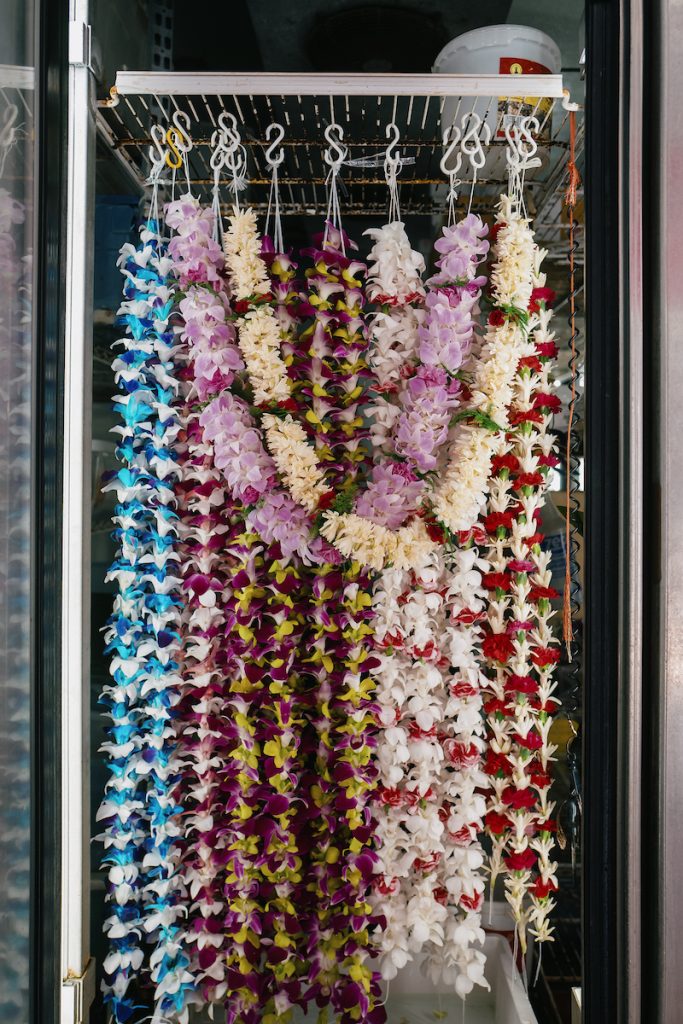
Photo: Aaron K. Yoshino
The next block over, still on Maunakea, I pass Cindy’s Lei and Flower Shoppe, opened in 1959. On a street lined with lei vendors, Cindy’s is routinely recognized by The Honolulu Star-Advertiser as Hawai‘i’s best lei shop. Across the street, Sing Cheong Yuan Bakery’s perpetual line snakes down the sidewalk. Inside, glass cases display egg tarts, manapua, dumplings, moon cakes and almond cookies. Happy customers spill out the door with cake boxes stuffed to the brim.

Photo: Aaron K. Yoshino
My final stop is Bo Wah Trading Co., a grocer and kitchen supply store since 1976. Here you’ll find the ingredients for your favorite Chinese recipes that aren’t available at typical grocery stores. Dried fish, mung bean powder, fermented curd. You can find packages of dried mushrooms here the size of 40-pound bags of fertilizer. Need a wok, bamboo steamer or Ovaltine? You’ll find it here.
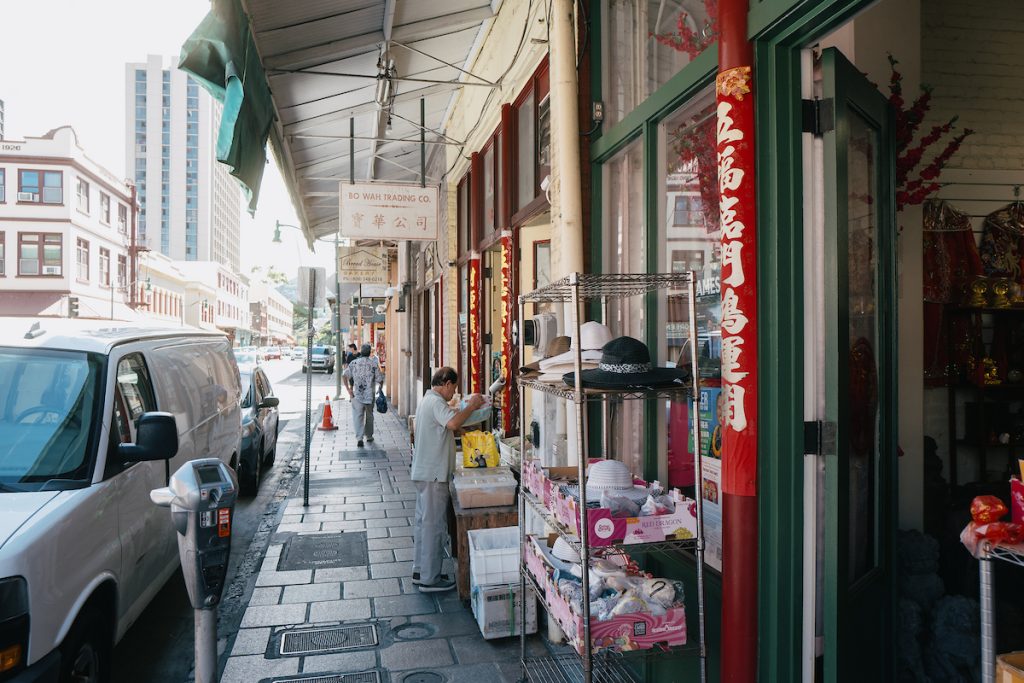
Photo: Aaron K. Yoshino
By the time I walk back to the bus stop on Hotel Street, the clouds have parted. I’ve got a shopping bag heavy with mangos, shoyu chicken and black bean sauce, a caffeine buzz and a full stomach. And $3 still in my pocket to get home.
Sarah Burchard is a frequent contributor to HAWAIʻI Magazine.
Read on the original site
Open the publisher's page for the full experience